Sunday, August 27, 2017

The Monorail Project–Build Out Monorail Ridership Daily Trip Distribution

With the Skyliner gondola transit system announced to connect Hollywood Studios, Epcot, and some nearby resorts, I figured it is time to do some more work on the monorail project.

I have calculated the estimated demand for every hour of each segment of my preferred alternative monorail networks. However, to understand what they mean, it is important to understand how many people an hour a monorail can realistically carry.

The design capacity of any grade-separated transit line is determined by several factors:
  • total passengers per car
  • number of cars per train
  • headway (the time between train departures), which is the sum of:
    • minimum train separation in seconds
    • dwell time at station
To keep things simple, I am assuming that the total number of passengers per car will remain the same as in current Walt Disney World Monorail trains, at 60 people per car. I am assuming that the approximate dimensions of the monorail cars are limited by the width and height restrictions of the monorail where it goes through the Contemporary Resort.

Likewise, the Contemporary Resort also forms the overall maximum length of trains. Currently, the monorail station is the northern half of the building. But it is conceivable that the monorail station platform could be extended to run the length of the building (approximately 430 feet). If the monorail cars remain the same dimensions as they are currently, this creates a maximum train length of 13 cars.
Unfortunately, determining the headway of the monorail requires more than some simple extrapolations of the current monorail system.

From the beginning, I have been assuming that the monorail trains and stations would need to be reconfigured to allow for platform-level boarding. Platform level boarding is when the station platform is level with the floor of the train so passengers in wheelchairs can board without the use of a ramp. This eliminates the requirement for a cast member to be present at all stations to operate the ramp, and can dramatically reduce the required station dwell time.

I also assume that all the bugs in the automatic train control can be worked out to allow for the most efficient train spacing.

Because both of these characteristics are not present in the existing monorail system, I have to look to other transit systems to identify a realistic headway time.

Some metro systems have been known to operate with headways of as little as 70 seconds, but that is on metro systems that primarily serve commuters, people most likely to know where they are going and how things work. Perhaps a better comparison might be airport people movers such as the ones at the Orlando International Airport. An airport people mover's load and unload characteristics are similar to the monorail because they have platform level boarding, automated train control, and platform doors. Airport people movers are not as familiar to riders as urban metro systems, because they are not a part of the daily commute for most passengers. Additionally, the riders of such systems frequently have rolling suitcases which may take up space during passenger flows through doorways in a fashion similar to strollers upon exit and entry of the monorail at Walt Disney World.

An airport people mover system can have headways as fast as 90 seconds, but according to the Transportation Research Board's Transit Capacity and Quality of Service Manual, a more typical headway for such a system is 120 seconds.

Once the design capacity was determined using the numbers above, I calculated the achievable capacity. This is the capacity that a transit line can be reasonably assumed to achieve given the variability in demand across an operating hour. The Transit Capacity and Quality of Service Manual recommends a peak hour factor of 0.8 to be used. This means that if the design capacity for a specific segment is 1,000 people in an hour, it should be assumed that only 800 people in an hour will actually be carried before unacceptable train loads or queuing would be experienced.

Monorail Achievable Capacity for Two Minute Headway Operation by Train Length

Cars Per Train
6 (Existing)
7
8
9
10
11
12
13
Train Capacity
360
420
480
540
600
660
720
780
Achievable Train Capacity (Peak Hour Factor of 0.8)
288
336
384
432
480
528
576
624
Design Capacity (people per hour)
10,800
12,600
14,400
16,200
18,000
19,800
21,600
23,400
Achievable Capacity (people per hour)
8,640
10,080
11,520
12,960
14,400
15,840
17,280
18,720

Now that these capacities have been determined, we can look at the estimated hourly capacities of each network to determine what each network would look like (and whether it would even work at all).

When I first calculated these numbers, I wanted to create some GIFs that would show the estimated ridership on each segment for each hour of the day. Unfortunately, after spending my free time on this task for the last several months (I determined the ridership numbers in February 2017), I have come to the conclusion that either Data Driven Graphics in Photoshop defy logic or (more likely) that I bit off more than I could chew. So, I will instead present some charts showing the maximum hourly demand for each line and maps showing the peak hour passenger flows for each network. If anyone out there knows anything about Data Driven Graphics in Photoshop and wants to help, feel free to comment on this post. Because I still think it would be a helpful way to visualize the passenger flows on each network.

Network 1094 Characteristics

Line
Max. Hourly Passengers
Peak Hour
Peak Segment
Cars Per Train
Headway (minutes)
Cycle Time (minutes)
Trains Required
Park Connector B
22,139
10:00AM – 11:00AM
Hollywood Studios - Epcot
13
1.7
34.7
21
Existing Resort
2,163
10:00AM – 11:00AM
Grand Floridian - Magic Kingdom
13
8.0
15.9
2
Epcot Loop B
3,378
10:00AM – 11:00AM
Port Orleans French Quarter - Epcot
13
9.9
9.9
1
Epcot Loop E
8,193
10:00AM – 11:00AM
Saratoga Springs - Disney Springs West Side
13
4.0
31.9
8
Studios Loop A
4,559
10:00AM – 11:00AM
Boardwalk - Hollywood Studios
13
5.3
15.9
3
Animal Kingdom Loop A
6,392
10:00AM – 11:00AM
All Star - Animal Kingdom
13
4.7
14.1
3

The monorail network with the highest score per mile, Network 1094, has one link with a passenger demand greater than the maximum achievable capacity of a monorail at Disney World given my original constraints. This link, connecting Hollywood Studios to Epcot, would require the longest trains possible to operate at headways of only 1.7 minutes. Unfortunately, this would not be possible to achieve on a consistent basis, so this network must be rejected.

Before we completely reject this network, I do want to discuss a possible confounding factor that may make this a more feasible option. When I started working on this project four years ago, there wasn’t even the slightest hint that the Skyliner gondola transit system would be built connecting Hollywood Studios to Epcot. It remains to be seen exactly how this system will operate and how it would be integrated with any monorail network expansion. But this gondola transit system is being built in the area where my network model suggests there would be the greatest demand. So potentially a network like this may still have a chance of being technically possible.

Network 838 Characteristics
Line
Max. Hourly Passengers
Peak Hour
Peak Segment
Cars Per Train
Headway (minutes)
Cycle Time (minutes)
Trains Required
Park Connector B
16,775
10:00AM – 11:00AM
Hollywood Studios - Epcot
13
2.2
34.7
16
Existing Resort
1.391
10:00AM – 11:00AM
Grand Floridian - Magic Kingdom
13
15.9
15.9
1
Epcot Loop B
2,580
10:00AM – 11:00AM
Old Key West - Epcot
13
7.8
15.5
2
Studios Loop A
2,701
10:00AM – 11:00AM
Yacht & Beach Club – International Gateway 
13
8.0
15.9
2
Animal Kingdom Loop A
3,912
10:00AM – 11:00AM
All Star – Animal Kingdom
13
7.0
14.1
2


Monorail network 838 was investigated because it has the least amount of new monorail track out of any of the 25 top-ranked networks. As you can see in the graphic above, my passenger demand model does not call for greater capacity than a monorail is technically capable of providing, given my initial constraints. This Network would carry an estimated 208,000 people a day--well over the 78,100 people per day that the Miami Metro Rail carries on its 24.4 miles of track (source). In fact, the ridership would be almost identical to that on Atlanta’s MARTA Rail and would carry more people than the Los Angeles Metro Rail. If this network was built, it would be the 9th busiest rapid transit system in the United States (source).

This network would call for 13 car trains that would arrive on 2.2 minute headways for the Park Connector B line. To provide operational flexibility, I assume that the 13 car trains would be used on the other lines, even though they could achieve an acceptable capacity with shorter trains. The table above indicates that the Epcot Loop C, Studios Loop A, and Animal Kingdom Loop A lines could have headways of approximately 7 or 8 minutes, so riders would have an average wait time of 3 or 4 minutes, comparable to the Existing Resort line and much better than the average headways on many major city’s rapid transit lines.

The Existing Resort line, however, would be able to operate with a single train and would have a headway of almost 16 minutes. I would consider this unacceptable, and although enough capacity could be provided with a single train, I think two trains would be necessary to maintain service quality and keep wait times within the limits described at the onset of this project.

Network 1112 Characteristics

Line
Max. Hourly Passengers
Peak Hour
Peak Segment
Cars Per Train
Headway (minutes)
Cycle Time (minutes)
Trains Required
Park Connector B
34,520
11:00AM - 12:00PM
Hollywood Studios - Epcot
13
1.1
34.7
33
Existing Resort
3,619
11:00AM – 12:00PM
Grand Floridian - Magic Kingdom
13
8.0
15.9
2
Epcot Loop B
5,080
11:00AM - 12:00PM
Port Orleans French Quarter - Epcot
13
4.9
9.9
2
Epcot Loop E
14,905
3:00PM - 4:00PM
Disney Springs West Side - Typhoon Lagoon
13
2.5
31.9
13
Studios Loop A
6,840
11:00AM – 12:00PM
Boardwalk – Hollywood Studios
13
3.8
11.3
3
Sports Loop A
11,597
11:00AM - 12:00PM
Art of Animation - Hollywood Studios
13
2.6
12.8
5
Animal Kingdom Loop A
9,611
11:00AM - 12:00PM
All Star – Animal Kingdom
13
3.5
14.1
4

Network 1112 was investigated because it was the highest ranked alternative to have a station at the ESPN Wide World of Sports. This network would carry a whopping 329,000 riders per day and would be the 6th busiest rapid transit system in the United States (behind San Francisco’s BART system which moves 35% more people on 140% more track (source)). However, this network would most definitely not work. At the peak hour in the morning with 13 car trains, the Park Connector B would need to operate at a headway of only 1.1 minute. My research suggests that some rapid transit systems in Eastern Europe may be able to operate at nearly that frequency, but the train doors open before the trains come to a complete stop, the riders are generally commuters who know where they are going and don’t have strollers, the weather is colder so people get out of their seats faster, and the liability and insurance requirements work very differently there than in the United States. In short, this network could not work. Not even the Skyliner gondola system can save it.

To make this system work, I would need to connect the Animal Kingdom side of the Park Connector B to Magic Kingdom and make two separate Park Connector lines running in loops in opposite directions. Maybe one day I will sketch out what that could look like. But for now, pretend this network doesn’t exist and we can move on to discuss something that could work.

Network 453 Characteristics


Line
Max. Hourly Passengers
Peak Hour
Peak Segment
Cars Per Train
Headway (minutes)
Cycle Time (minutes)
Trains Required
Park Connector A
10,382
10:00AM - 11:00AM
Epcot – Hollywood Studios
8
2.1
40.6
19
Existing Resort
2,163
10:00AM - 11:00AM
Grand Floridian - Magic Kingdom
8
8.0
15.9
2
Epcot Loop B
3,378
10:00AM - 11:00AM
Port Orleans French Quarter - Epcot
8
4.9
9.9
2
Epcot Loop E
5,626
10:00AM - 11:00AM
Saratoga Springs - Disney Springs West Side
8
4.0
31.9
8
Studios Loop A
4,559
10:00AM - 11:00AM
Boardwalk – Hollywood Studios
8
4.0
15.9
4

Network 453 was selected because at 23rd, it was the highest ranked alternative to use Park Connector A. This network would be able to operate eight car trains with a 2.1 minute headway on the Park Connector A line and headways of between four and five minutes on all of the resort loops except for the existing Resort Line. The existing Resort Line would be able to operate with only two trains, but the headway would be eight minutes, and would probably be noticeably longer than the waits on the other lines. So, because I can make up whatever I want to, I would recommend having three trains operating on the existing Resort Line so the headways would be in the neighborhood of five minutes like the other resort loops.

This network would carry 178,000 people per day and would be the 9th busiest rapid transit system in the United States (source). The eight-car trains in this network would dramatically reduce the amount that the existing stations would need to be modified, and in most cases would not even require a replacement of any existing track in station areas.

This transit system would require an additional 22 miles of track to build, 36 new eight car trains, 17 new stations and major reconstruction of all the existing stations. This system or any other system expansion described in these posts would optimistically cost hundreds of millions of dollars, and at the end of the day would only increase Disney’s bottom line by the amount that a premium could be charged to the hotel rooms that would be gaining monorail service access. As a fan of the Walt Disney World Monorails and theme parks in general, I am not sure whether I would want Disney to spend that kind of money on something like this instead of, say, a major expansion of an existing theme park.

The construction of such a system would cause major disruption to the existing monorail lines. And once it is built, a minor mechanical problem on a single train would cause incredible disruption resort-wide.

On the other hand, it would be separate guests traveling between parks and hotels from the growing surface traffic congestion across the resort. Wider roads and new bridges aren’t cheap either. Potentially, a monorail expansion could be taken on by the Reedy Creek Improvement District to take advantage of its ability to utilize tax free municipal bonds like what was done with the Disney Springs parking garages.

I am working with a friend who has done some cost estimation for large scale transportation projects so we can try to put together an order of magnitude cost estimate for one of these networks.
If you have any feedback or questions about my methodologies here, please feel free to comment on this post.

About the author: Ben Lytle is an AICP Certified Urban Planner living in Orlando, Florida. He is currently working at AECOM on the architectural facility design of a major theme park attraction in Central Florida and previously worked on the preliminary ground transportation infrastructure design for a theme park resort in Asia. The views expressed in this blog do not represent those of his employer, his employer’s clients, Walt Disney World, or potentially even his own. The information contained in this post is purely speculative and is derived from publicly available information as described elsewhere in this blog. The author does not make any claims to the accuracy of any information presented here. It has not been verified by anybody, and should not be taken any more seriously than any other Armchair Imagineering you read online. So there.

Saturday, January 2, 2016

The Monorail Project - Existing Monorail Ridership Daily Trip Distribution

I am working on modeling the hourly trips on the different monorail systems. To start, I modeled the existing system with the help of some contributors at the WDW Magic Forums. The overall daily ridership I think is likely to be quite accurate.
I also used Touring Plans crowd calendar data to create estimates of the number of guests entering and exiting the park in any given hour.
I'm not sure how realistic the distribution is, but I think it is a reasonable start. Using this distribution, The ridership on the existing monorail network looks like the following:
I don't think the busiest leg of the monorail is the stretch of the Resort line from the Grand Floridian to Magic Kingdom in the morning. Does anything else jump out as being off?

Saturday, July 4, 2015

The Monorail Project - Network Concepts

Once I described all the monorail network components, I had to develop a way to determine the best way to put them together. So, I used Excel to generate every possible combination of routes. Once I removed all the combinations that included two monorail lines serving the same resort, this left 1,201 possible combinations. Obviously, that is too many combinations to evaluate, so I ranked them based on station score per mile.

Below are the top 25 network combinations and the existing monorail network for comparison.


System number is an arbitrary number used to identify the alternative. System Combination lists the components of the network alternative, with '0' indicating no addition for a particular loop category. I allowed for multiple Epcot alternatives to be selected in a given network combination as long as no resort is served by two stations ('Epcot Loop CE' indicates that the system includes both Epcot Loop C and Epcot Loop E). Rank is the ranking of each combination by Score/Mile.

You may notice that the existing monorail network has the 75th highest Score/Mile. This does not necessarily mean that the Walt Disney World Monorail System should be extended. It is possible that the operational characteristics of any of the 74 higher-scoring systems would be worse than the existing system. And it is quite likely that the substantial capital costs of a greatly expanded system might not pay for themselves. But I was still surprised that any combination would have a higher station score than the existing system.

I selected the 1st, 7th, 10th, 23th-ranked alternatives for further analysis:

Build-Out 1094 was selected because it was the highest-ranked alternative. The ridership characteristics of this network should be nearly identical to the 11th ranked Build-Out 1098, which has all the same stations but uses the longer Hollywood Studios Loop B which does not cross the Hollywood Studios theme park.

Build-Out 838 was selected because it was the shortest network in the top 25 at 33 miles.

Build-Out 1112 was selected because it was the highest ranked alternative with a Sports Loop.

Build-Out 453 was selected because it was the highest-ranked alternative using Park Connector A.

I will be moving forward with the above concepts to determine the likely feasibility and operational characteristics of each monorail network alternative. Between now and the next post on this project, I will need to find a realistic number of guests per room at these hotels (at a peak season) so I can determine the daily ridership on each segment. I will also need to determine the average distribution of trips to theme parks throughout the day so I can begin to model the peak hour operating characteristics of the system. If you have any idea where I can find this data, please let me know.

Saturday, June 20, 2015

The Monorail Project - Resort Loops and Comparisons II

Today I will discuss the Animal Kingdom and Epcot transfer station lines.

Animal Kingdom Transfer Station


The Animal Kingdom Loop A has stops at both Animal Kingdom Lodge sections, the All Star Resorts, and Blizzard Beach. This means that it can only be considered along with the Park Connector B option without having a transfer at Blizzard Beach.

A transfer station at Blizzard Beach is not recommended because this water park currently has free parking. Even if parking at Blizzard Beach cost the same as the other theme parks, I could imagine this being inadvisable, because it may be considered more convenient to park close at the water park and ride the monorail to Hollywood Studios or Animal Kingdom. Come to think of it, this could also be considered an argument against the regular stop at Blizzard Beach on Park Connector A in general.


Animal Kingdom Loop B drops the Blizzard Beach station, which naturally implies that it would pair better with Park Connector A.


Animal Kingdom Loop C drops the stop at the All Star resorts and goes to Coronado Springs instead.


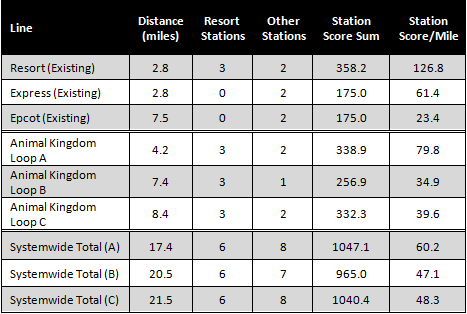
Generally, all three Animal Kingdom loops strike me as being somewhat poor choices for construction because of the long length of the lines and the way the resorts are laid out straddling the swamps of Reedy Creek.

Epcot Transfer Station


Like the resorts near Animal Kingdom, the resorts near Epcot are spread across both sides of a swampy body of water (the Sassagoula River). But the Epcot resorts are even more difficult to connect by monorail because the center of this section of the resort is home to the Lake Buena Vista Golf Course. For obvious reasons, any proposed monorail extension would need to avoid crossing a golf course or the impacted parts of the golf course would need to be reconstructed to avoid the alignment.

As a result, the Epcot Loop A gets a strange amoeba shape and is an unwieldy long route.


Epcot Loop B dispenses entirely with the idea that the monorail needs to serve the Downtown Disney area. However, it would be rather strange if the only hotels with direct access to the front entrance of Epcot had some of the least futuristic themes of all the Disney World resorts.


Epcot Loop C adds a stop at Old Key West by following the resort entrance road to the water taxi dock.


Epcot Loop D ignores the Port Orleans area entirely and just serves the Downtown Disney/Typhoon Lagoon area.


I was unhappy with how long Epcot Loop D was considering that it only stopped at one resort. So I decided to add stops for the resorts at Hotel Plaza Blvd. The Hotel Plaza Blvd South station is located near the Wyndham, Holiday Inn, and the Hilton resorts. The Hotel Plaza Blvd North station is near the Best Western, Doubletree, and the B resorts. Finally, I added a station at the Buena Vista Palace resort. Although these resorts are not owned by Disney, they are located on land owned by Disney. Therefore, the feasibility of these stations is similar to that of the station at the Swan and Dolphin.

For Epcot Loop E, I also added stations at Downtown Disney West Side and the Downtown Disney Marketplace. The station labeled Downtown Disney may or may not be included in a final version of this alternative. Regardless of how many stations are located at Downtown Disney, I only gave this alternative the station score points as if it stopped at Downtown Disney just once.


Somewhat surprisingly, the Station Score per Mile of the Epcot monorail loops are fairly consistent. In a complete build out, it is possible that Alternatives B or C could be built in addition to Alternatives D or E.


Next time I will discuss the possible combinations of routes I can combine to develop a complete system. The system-wide Station Score per Mile will help me identify the top ideal build outs of a Disney World monorail system. If there are any possible monorail networks that have a higher score than the existing monorail, it will be kind of cool.

Tuesday, April 21, 2015

Museum of Science and Invention

The Museum of Science and Invention from the world of Phineas and Ferb was a project created by myself and Doug Rakoczy for the University of Florida/Point Park University Team for the 2013 Walt Disney Imagineering ImagiNations Design Competition. [Note: This project is the sole property of Walt Disney Imagineering and all rights to use these ideas are exclusive to Walt Disney Imagineering. The competition is a way for students and recent graduates to showcase their talents and for Walt Disney Imagineering to identify new talent. All intellectual property used in this project belongs to its respective owners, and this blog has no affiliation to the Walt Disney company in any way.]

This was the second time Doug and I collaborated on an ImagiNations design contest and the third time I participated. The prompt was to design an experience for a large city that transforms it for the enjoyment of its citizens and visitors. After considering several possibilities, we decided to develop a concept based on Phineas and Ferb because of the comic and educational possibilities of the show. In particular, we liked how the show seems to exist in an alternative reality in which science is real, but making things work is much easier than in real life. This, we reasoned, would make a great basis for a science museum.

I created the concept art, while Doug was responsible for the vehicle design and modeling. We both collaborated on the story. At the end of the day, we did not make it to the next round of the competition, but we generated a lot of quality work we are both proud of.

Below, I have reproduced the text and imagery from our submission:

Project Summary:
The Doofenshmirtz Evil Incorporated Main Building rises prominently above the skyline of Pittsburgh, transforming the Pittsburgh Tri-State Area into the Danville Tri-State Area from Phineas and Ferb. The Museum of Science and Invention is housed inside this distinctive, environmentally friendly building.

Dr. Doofenshmirtz's latest diabolical plan to take over the Tri-State-Area involves winning the trust and admiration of the citizens of Danville by opening a museum. In addition to highlighting some of Dr. Doofenshmirtz's latest inventions, this museum has an educational mission to inspire children to learn about science and engineering through interactive hands on exhibits. Each exhibit starts with a common everyday invention and breaks it down into fundamental components explained through hands on exhibits and interactive media. Within some of the exhibits are inventions made by Phineas and Ferb, including Where’s Perry? a hydrogen balloon ride over parts of the museum and across Danville on a quest to find Perry while Candace tries to bust everyone.

The finale experience is the Elevator-Inator, an elevator which can travel horizontally and vertically. Guests board the vehicle and are lifted into Dr. Doofenshmirtz's lab, where he reveals that the whole museum was a ruse to fool the residents of Danville so he can take over the Tri-State Area. Agent P arrives and wrestles Dr. Doofenshmirtz for the ride’s remote control, sending the vehicle careening through Dr. Doofenshmirtz’s workshop and activating some of his evil inventions. Agent P eventually defeats Dr. Doofenshmirtz by exploding one of Phineas and Ferb’s hydrogen balloons while guests in the Elevator-Inator are returned safely to the ground.

Story Behind the Design:

Welcome to the greatest museum in the Tri-State Area! Dr. Doofenshmirtz invites you and your family to the new Museum of Science and Invention! Inside, family members will be able to dive head first into the world of science, engineering, and technology.

At least, that’s what Dr. Doofenshmirtz wants you to think. In addition to sharing his love of science, the purpose of this museum is to brainwash the citizens of the Tri-State Area into handing over the deeds to their houses. Dr. Doofenshmirtz invented the Elevator-Inator, but he decided it wasn’t evil enough. So he installed a Mind Control-Inator to the seats so he could make guests give him the deeds to their property.

Phineas and Ferb were taken to the museum by Candace today. When the boys realize Perry is missing, they build hydrogen balloons to find him. They invite other museum patrons to help them locate Perry. Meanwhile, Perry has been captured by Dr. Doofenshmirtz while attempting to foil his plot. Agent P eventually defeats Dr. Doofenshmirtz by exploding one of Phineas and Ferb’s hydrogen balloons near Dr. Doofenshmirtz and reversing the Mind Control-Inator. Once again the day is saved, thanks to Agent P!

Guest Experience:
Every guest that visits the museum is transported into the world of Phineas and Ferb and experiences interactive, hands on exhibits about science and the history of invention. It is the mission of the museum to enrich the ideas, imaginations, and passion of all people and to explore the world around them in the light of science. Exhibits range from hands-on demonstrations to rides and interactive media, ensuring that there is material presented in ways suitable for all types of learners. In addition to the many exhibits and attractions, several programs are offered for the educational outreach of school children. The Doofenshmirtz Summer School of Science is where children will learn how to become the next generation of mad scientists… er, inventors! Programs for school groups will also be available. This museum will entertain and inspire tourists from around the world, but it will also provide a valuable educational environment for the people who call the Tri-State Area home.


The full-scale recreation of the Doofenshmirtz Evil Inc. Main Building will permanently transform Pittsburgh into Danville, and the museum will inspire the children of Pittsburgh with Phineas and Ferb’s spirit of invention.

Pittsburgh was selected to be transformed into Danville because it is the second largest Tri-State metro area in the United States, and the largest without a state-of-the-art family science museum. Home to over 2.6 million people, the Pittsburgh Tri-State area has the population necessary to support this educational entertainment complex.


“Welcome, citizens of the Tri-State Area! I hope you enjoy my museum that is definitely not some sort of evil scheme.”

Guests enter through the Atrium of Genius, a tribute to our generation’s greatest inventor, complete with a collection of his masterpieces. Each of the museum’s exhibits can be accessed through this atrium, but the exhibits are also designed to flow from one to another internally.


Exhibits include full-scale recreations of historic moments in the progression of ideas along with demonstrations, displays and interactive media. Shown here is part of the Make it Float-Inator, where the Wright Brothers perfected the ideal wing shape for flight. Here, guests can test different wing shapes in a wind tunnel, read how it was done or interact with the Wright Brothers in person. Lighter-than-air flight is described in Where’s Perry? While visiting this exhibit, Phineas and Ferb realized Perry was missing, so they invented hydrogen balloons to look for him. This ride (a suspended variation of the Omnimover ride system) goes over this wing of the museum before leaving the building and soaring over Danville (done in miniatures, like Peter Pan’s Flight).


Attractions and Exhibits:
The Lair Restaurant and Observatory is a family dining environment complete with great views of Danville and furnishings fit only for the future ruler of the Tri-State Area.

The Doofenshmirtz Evil Inc. Hotel and Suites are generally less evil than most of the Doofenshmirtz Evil Inc. projects, because it is operated by Doofenshmirtz’s bank, with whom he is late on mortgage payments.

The 1st floor is occupied by the Hotel Lobby, Museum entrance and Retail Space. Guests exiting the museum do so through a Disney Store featuring an extensive collection of Phineas and Ferb merchandise.

Museum guests enter through the 1st Floor, ascend stairs to the Atrium of Genius, and travel by escalator to the top museum floor. Each exhibit flows into the next, although they are all accessible through the Atrium of Genius.

The Time Warp-Inator allows guests to witness the discovery of some of the most groundbreaking inventions.

Follow in the footsteps of Henry Ford and design the next generation of electric powered vehicles at the Car-Inator.

Discover what it really takes to make things fly in the Make it Float-Inator complete with a hydrogen balloon ride invented by Phineas and Ferb.

Finally, ride Dr. Doofenshmirtz's latest invention, The Elevator-Inator! On this thrilling ride, witness experiments that are in progress and discover what it really takes to be an inventor.


The Elevator-Inator is a new style of family thrill ride that takes the classic dark ride and turns it on its side. The vehicle combines conventional simulator movement with a unique track configuration to simulate an elevator that can travel up, down, left and right. In order to be accessible to the greatest number of guests, seats and restraints are able to be raised and lowered so that the height restriction is only 36”. In order to be accessible to guests with disabilities, those needing special assistance will be placed in a custom wheel chair at the station. Once the other guests are seated, the wheel chair is locked into position in the center seat of the front row.


The Elevator-Inator is driven by a unique system that uses a worm gear and sprocket that connects to the track. On the track itself is a 3” wide toothed bar which allows the car to climb the vertical portions of track. Each car is powered by 2 bus bars that also run the length of the track. Linear actuators on the top and back of the car allow it to rock front and back as well as side to side to keep the car level. Speakers are located in the head rests and under each seat in order to produce binaural sounds to create the effect of the Mind Control-Inator.

Guests board the vehicle and are lifted into Dr. Doofenshmirtz's lab, where he reveals that the whole museum was a ruse. He activates the Mind Control-Inator but before the riders give up their homes, Agent P escapes and wrestles Dr. Doofenshmirtz for the ride’s remote control, sending the vehicle careening through the workshop and activating some of his evil inventions. Agent P eventually defeats Dr. Doofenshmirtz by exploding one of Phineas and Ferb’s hydrogen balloons while guests in the Elevator-Inator are returned safely to the ground. Once again, the day is saved, thanks to Agent P!

***

I hope you've enjoyed reading about The Museum of Science and Invention. We only had a few weeks to work on this project, which we completed while I was a full time graduate student who also worked 20 hours a week as a research assistant. So I am extremely happy that we managed to complete as much as we did. The only thing I wished I could have added to this was a layout for the Elevator-Inator ride. Maybe I will get back to it one day.

Monday, April 20, 2015

The Monorail Project - Resort Loops and Comparisons

Now that I have outlined the main theme park connector monorail, I can begin to fill in the extensions to the resorts. I will show maps of individual concepts grouped based on their theme park transfer station. Where multiple options are given, I will compare them based on their combined scores and lengths.

Magic Kingdom Transfer Station


The first addition is the extension of the existing resort line to stop at Wilderness Lodge. It would require approximately one mile of new monorail alignment between the Transportation and Ticket Center (TTC) and The Contemporary Resort. The big downside to this alternative is that it would preclude the land between the TTC and The Contemporary from being able to be the site of a resort with a monorail station.

If the Park Connector line described in the previous post has to be built new around the Seven Seas Lagoon for capacity reasons, the Wilderness Lodge Extension could be built for relatively little cost. The existing Resort monorail beam between The Contemporary and TTC stations could be used for the Express line and the new Park Connector line could use the existing Express monorail beam.

Hollywood Studios Transfer Station


All three versions of The Hollywood Studios Loop have a station at the entrance to Hollywood Studios and at the International Gateway entrance to Epcot. The Hollywood Studios Loops A and B also have stops at the Boardwalk Resort, a combined station for the Yacht and Beach Club resorts, and a combined station for the Swan and Dolphin resorts.

Loop A crosses Hollywood Studios between Tower of Terror and the Fantasmic! theater and at the park entrance. The visibility of the monorail within the park is not necessarily an issue in these areas for two reasons: a monorail system was proposed for Los Angeles by the Alweg company in the 1960's, and the area around Fantasmic! has a contemporary aesthetic. The theme park crossing may limit future expansion in the areas adjacent to the monorail, so the other alternatives for this loop do not cross the theme park.


Loop B has all the same stations as Loop A, but it goes around Hollywood Studios instead of through it.


Loop C has an additional station at Blizzard Beach and Coronado Springs. However, it is still the Hollywood Studios alternative with the lowest Station Score/Mile. This alternative is the only Hollywood Studios-based alternative with a possible station at Coronado Springs. Coronado Springs had the 15th highest Resort Score (of 20) and has been classified as having a moderately-convenient layout for monorail transit. So It may not end up having a station in every final resort network alternative.

It is interesting to note here that all three Hollywood Studio Loop alternatives have a substantially higher Station Score/Mile than the existing Resort line. This suggests any of these alternatives would be very highly used if it were built, and it suggests that a large number of rooms (as much as 6,580) would increase in value because of the monorail.

One of the downsides to all of these alternatives is that they include a stop for the Swan and Dolphin resorts, which are not owned by Disney. This is a problem because Disney may not be able to convince the hotel's owners to pay a premium to pay for the construction, staffing, and operation of the Monorail at that site. If Disney chose not to include a stop there because of these negotiations, Disney would look bad for not including a station because the average guest doesn't know that the Swan and Dolphin are not Disney-owned resorts. I would suspect that after the difficulties in justifying an expansion of the monorail system financially, that this may be the second biggest obstacle to any monorail expansion.

The Hollywood Studios station is also ideally located as a transfer point for a monorail serving the resorts located on the southeast portion of Walt Disney World near the ESPN Wide World of Sports. Below are three possible alignments connecting Hollywood Studios to the sports complex and the nearby resorts.


The Sports Loop A serves the Caribbean Beach, Pop Century, and Art of Animation resorts as well as the ESPN Wide World of Sports. Art of Animation and Pop Century had the 16th and 13th highest Resort Score (of 20, respectively) and had been classified as having a moderately-convenient layout for monorail transit. The Caribbean Beach resort had the 19th highest score and a low-convenience layout for monorail. Therefore, all three resorts along this alternative have relatively low priority for monorail access. The one big advantage to this line (and the two other Sports Loop alternatives) is the station at the ESPN Wide World of Sports and the fact that many people coming to the sports complex stay at the nearby resorts.


Sports Loop B adds the All Star Resorts to the station lineup, which is a good fit for this line because sports groups using the Wide World of Sports are frequently booked in the All Star Resorts. Unfortunately, at 8.2 miles, this alternative is one of the longest proposed in the system and is longer than the existing Epcot line by 0.7 miles.


Sports Loop C drops the Caribbean Beach station from the layout of Sports Loop B, saving 0.9 miles. However, both Sports Loop B and C have a lower Station Score/Mile then Sports Loop A. All three alternatives have substantially a lower Station Score/Mile then the existing Resort line, and would probably be relatively low priority.

I will discuss the Animal Kingdom and Epcot transfer station lines in the next post. Let me know if you have any thoughts about the alternatives I discussed here. I would love to hear your ideas.