Showing posts with label Walt Disney World. Show all posts

Sunday, February 4, 2018

The Monorail Project - Phasing


Recently, there was an article posted at Theme Park University about how the existing Walt Disney World monorail system is overextended. The essay below is a slightly expanded response to that article. 

In the article, Josh Young describes the recent string of well-publicized monorail problems and asks how could Disney World go about getting the monorail system back into good shape? And how could it possibly be expected to handle any of the increase in demand that the new attractions currently under construction and beyond will surely generate?

The most obvious and cheapest solution to fix the reliability issues would be to hire more maintenance workers. Without knowing any specifics, it stands to reason that additional people can do the same work in a shorter time. But it is also possible that some tasks simply take too long to be completed in the short time when the monorail is closed for the night.

If those tasks are train-maintenance related, they could be solved by purchasing an additional train or two. This would increase the amount of time each train could be out-of-service without impacting system capacity. It would be very expensive, and would probably not improve capacity as much as it would improve reliability.

If the tasks are track-maintenance related, I can’t imagine that additional labor would be insufficient for all but the most serious problems. Urban mass transit systems the world over successfully maintain much longer track networks in similar time frames.

To seriously increase the capacity of the monorail would require adding trains and/or allowing for platform-level boarding. Both of these tasks would probably require closing the Resort Line for a few months. So if I was in charge, I would do both.

For the sake of argument, I will describe what I think it might take to upgrade the monorail system to have 8-car trains and platform level boarding. Please note that everything I say here should be suspect. I am not currently employed by Disney, and I have never been involved with anything that would give me any insight to this problem that isn’t publically available. This is just a thought experiment from a person with some theme park operations and design experience who has been researching the Disney monorails in his spare time since 2013.

The first step in converting the system to platform-level boarding would be to order new trains or modify the existing trains so that the doors do not swing out. These pocket doors would probably negatively impact the current sleek Bob Gurr-designed “LearJet” look of the trains. So the trains may need to be entirely redesigned.

A new custom train set would probably take on the order of magnitude of 1 1/2 years to receive from the manufacturer. But the new trains (with 6 cars) would need to replace the old ones before any station work can begin. The new trains might take six months of after-hours testing before they can be in normal operation.

Before any trains could be increased to 8 car lengths, the monorail barn would need to be expanded to accommodate longer trains. This would probably be completed while the trains are being manufactured. This monorail barn expansion might impact the maintenance of existing monorail trains, but it may be possible to phase the work so this is not a problem. I would be curious to know if the monorail barn was expanded when the monorail went from five car train to six car train operations in the 1980s.

Once the fleet has been converted to new six car trains, the Epcot line and the Resort line would close for the stations to be lengthened to accommodate eight car trains. The Epcot station remodel would also impact Epcot parking lot tram operation, because the station is above the tramway.

The new stations would be built to the height of the new monorail train floors, and would have a minimal gap to allow wheelchair access through every door without a ramp.

Work on the Magic Kingdom and TTC stations would need to be done as quickly as possible. But luckily, they are both big enough buildings that construction should be possible 24 hours a day without disrupting the operation of the active monorail line that is adjacent. Unfortunately, the monorail tracks at the Polynesian, Contemporary, and Grand Floridian stations are directly adjacent to one another. So the expansion of these stations would probably only be possible overnight when the Express line is not in service. This phase might take four months?

Once the Resort line stations have been expanded and have platform level boarding, the track of the Resort line could be put back in service as the new temporary Express line. At this point, the Epcot line could reopen and both the temporary Express line and the Epcot line six car trains could be expanded to eight cars.

At this time, work on the Express line platforms at the TTC and Magic Kingdom would be completed, maybe taking another four months. This would mean that for eight months, the Polynesian, Contemporary, and Grand Floridian resorts would be without monorail service. These resorts would also have major construction near their main entrances or (in the case of the Contemporary) in their lobbies for four months.

This would probably cost the same as one or two major E-ticket attractions. And when all the work is done, nobody will notice it. I mean, they currently notice the long lines for the monorail, but when that goes away, they won’t remember that their used to be long lines for it. Like expanding restroom capacity, nobody thinks about transportation capacity until it is inadequate. And like expanding restroom capacity, sometimes it needs to be done.

Like I said above, my numbers are likely to be very inaccurate, because I don’t really know what I am talking about. But this is how I see the Disney World monorail problem today.
In the comments to the original article, one of the most common responses was about how the monorail should be converted to a transit-sized peoplemover system with continuous loading. I think the idea is fairly common among theme park fans. But it is fundamentally flawed.

Believe it or not, a continually moving train actually has a lower maximum theoretical capacity than a train that stops for boarding, assuming the train length can be extended. Think of it this way: a continuously moving train has to have a moving sidewalk entrance and exit width narrow enough that everyone can hold onto a handrail at the transition. Also, such a system has to come to a stop every time a guest arrives who is incapable of stepping onto a moving platform.

Think about how frequently Spaceship Earth has to go to crawl mode or stop while you ride it. I could imagine that Spaceship Earth has probably about half the theoretical maximum capacity for a continuously moving ride system. So that would mean a capacity of maybe 6,000 people per hour? Anything more than that would require such a wide moving sidewalk that I think it would be wider than the current Magic Kingdom monorail station platforms.

The limiting factor to conventional monorail capacity is train length and dispatch interval. The dispatch interval is based on the control system for the train and boarding characteristics such as door width, the presence of a step into the cabin, and the interior layout of the cabin. The door width and cabin interior layout are probably about as efficient as they can be without removing seats in terms of capacity. But the current requirements that wheelchairs need portable ramps to board (a function of door design and the height of the station platform) are what makes the trains take up to twice as long to dispatch as is theoretically possible.

Fixing that, in addition to lengthening the trains could dramatically increase the capacity. I did some back-of-the-envelope calculations and figured that solving the platform level boarding issue by eliminating the step into the cabin would give the monorail a theoretical maximum hourly capacity of 8,640 with a two minute dispatch interval. If the number of trains were increased from the current six to eight, the capacity would be 11,520 people per hour. To go completely crazy and make the trains as long as the Contemporary Resort (13 cars) would give you a capacity of 18,720 people per hour. You can read about my methodology here.

Sunday, August 27, 2017

The Monorail Project–Build Out Monorail Ridership Daily Trip Distribution

With the Skyliner gondola transit system announced to connect Hollywood Studios, Epcot, and some nearby resorts, I figured it is time to do some more work on the monorail project.

I have calculated the estimated demand for every hour of each segment of my preferred alternative monorail networks. However, to understand what they mean, it is important to understand how many people an hour a monorail can realistically carry.

The design capacity of any grade-separated transit line is determined by several factors:
  • total passengers per car
  • number of cars per train
  • headway (the time between train departures), which is the sum of:
    • minimum train separation in seconds
    • dwell time at station
To keep things simple, I am assuming that the total number of passengers per car will remain the same as in current Walt Disney World Monorail trains, at 60 people per car. I am assuming that the approximate dimensions of the monorail cars are limited by the width and height restrictions of the monorail where it goes through the Contemporary Resort.

Likewise, the Contemporary Resort also forms the overall maximum length of trains. Currently, the monorail station is the northern half of the building. But it is conceivable that the monorail station platform could be extended to run the length of the building (approximately 430 feet). If the monorail cars remain the same dimensions as they are currently, this creates a maximum train length of 13 cars.
Unfortunately, determining the headway of the monorail requires more than some simple extrapolations of the current monorail system.

From the beginning, I have been assuming that the monorail trains and stations would need to be reconfigured to allow for platform-level boarding. Platform level boarding is when the station platform is level with the floor of the train so passengers in wheelchairs can board without the use of a ramp. This eliminates the requirement for a cast member to be present at all stations to operate the ramp, and can dramatically reduce the required station dwell time.

I also assume that all the bugs in the automatic train control can be worked out to allow for the most efficient train spacing.

Because both of these characteristics are not present in the existing monorail system, I have to look to other transit systems to identify a realistic headway time.

Some metro systems have been known to operate with headways of as little as 70 seconds, but that is on metro systems that primarily serve commuters, people most likely to know where they are going and how things work. Perhaps a better comparison might be airport people movers such as the ones at the Orlando International Airport. An airport people mover's load and unload characteristics are similar to the monorail because they have platform level boarding, automated train control, and platform doors. Airport people movers are not as familiar to riders as urban metro systems, because they are not a part of the daily commute for most passengers. Additionally, the riders of such systems frequently have rolling suitcases which may take up space during passenger flows through doorways in a fashion similar to strollers upon exit and entry of the monorail at Walt Disney World.

An airport people mover system can have headways as fast as 90 seconds, but according to the Transportation Research Board's Transit Capacity and Quality of Service Manual, a more typical headway for such a system is 120 seconds.

Once the design capacity was determined using the numbers above, I calculated the achievable capacity. This is the capacity that a transit line can be reasonably assumed to achieve given the variability in demand across an operating hour. The Transit Capacity and Quality of Service Manual recommends a peak hour factor of 0.8 to be used. This means that if the design capacity for a specific segment is 1,000 people in an hour, it should be assumed that only 800 people in an hour will actually be carried before unacceptable train loads or queuing would be experienced.

Monorail Achievable Capacity for Two Minute Headway Operation by Train Length

Cars Per Train
6 (Existing)
7
8
9
10
11
12
13
Train Capacity
360
420
480
540
600
660
720
780
Achievable Train Capacity (Peak Hour Factor of 0.8)
288
336
384
432
480
528
576
624
Design Capacity (people per hour)
10,800
12,600
14,400
16,200
18,000
19,800
21,600
23,400
Achievable Capacity (people per hour)
8,640
10,080
11,520
12,960
14,400
15,840
17,280
18,720

Now that these capacities have been determined, we can look at the estimated hourly capacities of each network to determine what each network would look like (and whether it would even work at all).

When I first calculated these numbers, I wanted to create some GIFs that would show the estimated ridership on each segment for each hour of the day. Unfortunately, after spending my free time on this task for the last several months (I determined the ridership numbers in February 2017), I have come to the conclusion that either Data Driven Graphics in Photoshop defy logic or (more likely) that I bit off more than I could chew. So, I will instead present some charts showing the maximum hourly demand for each line and maps showing the peak hour passenger flows for each network. If anyone out there knows anything about Data Driven Graphics in Photoshop and wants to help, feel free to comment on this post. Because I still think it would be a helpful way to visualize the passenger flows on each network.

Network 1094 Characteristics

Line
Max. Hourly Passengers
Peak Hour
Peak Segment
Cars Per Train
Headway (minutes)
Cycle Time (minutes)
Trains Required
Park Connector B
22,139
10:00AM – 11:00AM
Hollywood Studios - Epcot
13
1.7
34.7
21
Existing Resort
2,163
10:00AM – 11:00AM
Grand Floridian - Magic Kingdom
13
8.0
15.9
2
Epcot Loop B
3,378
10:00AM – 11:00AM
Port Orleans French Quarter - Epcot
13
9.9
9.9
1
Epcot Loop E
8,193
10:00AM – 11:00AM
Saratoga Springs - Disney Springs West Side
13
4.0
31.9
8
Studios Loop A
4,559
10:00AM – 11:00AM
Boardwalk - Hollywood Studios
13
5.3
15.9
3
Animal Kingdom Loop A
6,392
10:00AM – 11:00AM
All Star - Animal Kingdom
13
4.7
14.1
3

The monorail network with the highest score per mile, Network 1094, has one link with a passenger demand greater than the maximum achievable capacity of a monorail at Disney World given my original constraints. This link, connecting Hollywood Studios to Epcot, would require the longest trains possible to operate at headways of only 1.7 minutes. Unfortunately, this would not be possible to achieve on a consistent basis, so this network must be rejected.

Before we completely reject this network, I do want to discuss a possible confounding factor that may make this a more feasible option. When I started working on this project four years ago, there wasn’t even the slightest hint that the Skyliner gondola transit system would be built connecting Hollywood Studios to Epcot. It remains to be seen exactly how this system will operate and how it would be integrated with any monorail network expansion. But this gondola transit system is being built in the area where my network model suggests there would be the greatest demand. So potentially a network like this may still have a chance of being technically possible.

Network 838 Characteristics
Line
Max. Hourly Passengers
Peak Hour
Peak Segment
Cars Per Train
Headway (minutes)
Cycle Time (minutes)
Trains Required
Park Connector B
16,775
10:00AM – 11:00AM
Hollywood Studios - Epcot
13
2.2
34.7
16
Existing Resort
1.391
10:00AM – 11:00AM
Grand Floridian - Magic Kingdom
13
15.9
15.9
1
Epcot Loop B
2,580
10:00AM – 11:00AM
Old Key West - Epcot
13
7.8
15.5
2
Studios Loop A
2,701
10:00AM – 11:00AM
Yacht & Beach Club – International Gateway 
13
8.0
15.9
2
Animal Kingdom Loop A
3,912
10:00AM – 11:00AM
All Star – Animal Kingdom
13
7.0
14.1
2


Monorail network 838 was investigated because it has the least amount of new monorail track out of any of the 25 top-ranked networks. As you can see in the graphic above, my passenger demand model does not call for greater capacity than a monorail is technically capable of providing, given my initial constraints. This Network would carry an estimated 208,000 people a day--well over the 78,100 people per day that the Miami Metro Rail carries on its 24.4 miles of track (source). In fact, the ridership would be almost identical to that on Atlanta’s MARTA Rail and would carry more people than the Los Angeles Metro Rail. If this network was built, it would be the 9th busiest rapid transit system in the United States (source).

This network would call for 13 car trains that would arrive on 2.2 minute headways for the Park Connector B line. To provide operational flexibility, I assume that the 13 car trains would be used on the other lines, even though they could achieve an acceptable capacity with shorter trains. The table above indicates that the Epcot Loop C, Studios Loop A, and Animal Kingdom Loop A lines could have headways of approximately 7 or 8 minutes, so riders would have an average wait time of 3 or 4 minutes, comparable to the Existing Resort line and much better than the average headways on many major city’s rapid transit lines.

The Existing Resort line, however, would be able to operate with a single train and would have a headway of almost 16 minutes. I would consider this unacceptable, and although enough capacity could be provided with a single train, I think two trains would be necessary to maintain service quality and keep wait times within the limits described at the onset of this project.

Network 1112 Characteristics

Line
Max. Hourly Passengers
Peak Hour
Peak Segment
Cars Per Train
Headway (minutes)
Cycle Time (minutes)
Trains Required
Park Connector B
34,520
11:00AM - 12:00PM
Hollywood Studios - Epcot
13
1.1
34.7
33
Existing Resort
3,619
11:00AM – 12:00PM
Grand Floridian - Magic Kingdom
13
8.0
15.9
2
Epcot Loop B
5,080
11:00AM - 12:00PM
Port Orleans French Quarter - Epcot
13
4.9
9.9
2
Epcot Loop E
14,905
3:00PM - 4:00PM
Disney Springs West Side - Typhoon Lagoon
13
2.5
31.9
13
Studios Loop A
6,840
11:00AM – 12:00PM
Boardwalk – Hollywood Studios
13
3.8
11.3
3
Sports Loop A
11,597
11:00AM - 12:00PM
Art of Animation - Hollywood Studios
13
2.6
12.8
5
Animal Kingdom Loop A
9,611
11:00AM - 12:00PM
All Star – Animal Kingdom
13
3.5
14.1
4

Network 1112 was investigated because it was the highest ranked alternative to have a station at the ESPN Wide World of Sports. This network would carry a whopping 329,000 riders per day and would be the 6th busiest rapid transit system in the United States (behind San Francisco’s BART system which moves 35% more people on 140% more track (source)). However, this network would most definitely not work. At the peak hour in the morning with 13 car trains, the Park Connector B would need to operate at a headway of only 1.1 minute. My research suggests that some rapid transit systems in Eastern Europe may be able to operate at nearly that frequency, but the train doors open before the trains come to a complete stop, the riders are generally commuters who know where they are going and don’t have strollers, the weather is colder so people get out of their seats faster, and the liability and insurance requirements work very differently there than in the United States. In short, this network could not work. Not even the Skyliner gondola system can save it.

To make this system work, I would need to connect the Animal Kingdom side of the Park Connector B to Magic Kingdom and make two separate Park Connector lines running in loops in opposite directions. Maybe one day I will sketch out what that could look like. But for now, pretend this network doesn’t exist and we can move on to discuss something that could work.

Network 453 Characteristics


Line
Max. Hourly Passengers
Peak Hour
Peak Segment
Cars Per Train
Headway (minutes)
Cycle Time (minutes)
Trains Required
Park Connector A
10,382
10:00AM - 11:00AM
Epcot – Hollywood Studios
8
2.1
40.6
19
Existing Resort
2,163
10:00AM - 11:00AM
Grand Floridian - Magic Kingdom
8
8.0
15.9
2
Epcot Loop B
3,378
10:00AM - 11:00AM
Port Orleans French Quarter - Epcot
8
4.9
9.9
2
Epcot Loop E
5,626
10:00AM - 11:00AM
Saratoga Springs - Disney Springs West Side
8
4.0
31.9
8
Studios Loop A
4,559
10:00AM - 11:00AM
Boardwalk – Hollywood Studios
8
4.0
15.9
4

Network 453 was selected because at 23rd, it was the highest ranked alternative to use Park Connector A. This network would be able to operate eight car trains with a 2.1 minute headway on the Park Connector A line and headways of between four and five minutes on all of the resort loops except for the existing Resort Line. The existing Resort Line would be able to operate with only two trains, but the headway would be eight minutes, and would probably be noticeably longer than the waits on the other lines. So, because I can make up whatever I want to, I would recommend having three trains operating on the existing Resort Line so the headways would be in the neighborhood of five minutes like the other resort loops.

This network would carry 178,000 people per day and would be the 9th busiest rapid transit system in the United States (source). The eight-car trains in this network would dramatically reduce the amount that the existing stations would need to be modified, and in most cases would not even require a replacement of any existing track in station areas.

This transit system would require an additional 22 miles of track to build, 36 new eight car trains, 17 new stations and major reconstruction of all the existing stations. This system or any other system expansion described in these posts would optimistically cost hundreds of millions of dollars, and at the end of the day would only increase Disney’s bottom line by the amount that a premium could be charged to the hotel rooms that would be gaining monorail service access. As a fan of the Walt Disney World Monorails and theme parks in general, I am not sure whether I would want Disney to spend that kind of money on something like this instead of, say, a major expansion of an existing theme park.

The construction of such a system would cause major disruption to the existing monorail lines. And once it is built, a minor mechanical problem on a single train would cause incredible disruption resort-wide.

On the other hand, it would be separate guests traveling between parks and hotels from the growing surface traffic congestion across the resort. Wider roads and new bridges aren’t cheap either. Potentially, a monorail expansion could be taken on by the Reedy Creek Improvement District to take advantage of its ability to utilize tax free municipal bonds like what was done with the Disney Springs parking garages.

I am working with a friend who has done some cost estimation for large scale transportation projects so we can try to put together an order of magnitude cost estimate for one of these networks.
If you have any feedback or questions about my methodologies here, please feel free to comment on this post.

About the author: Ben Lytle is an AICP Certified Urban Planner living in Orlando, Florida. He is currently working at AECOM on the architectural facility design of a major theme park attraction in Central Florida and previously worked on the preliminary ground transportation infrastructure design for a theme park resort in Asia. The views expressed in this blog do not represent those of his employer, his employer’s clients, Walt Disney World, or potentially even his own. The information contained in this post is purely speculative and is derived from publicly available information as described elsewhere in this blog. The author does not make any claims to the accuracy of any information presented here. It has not been verified by anybody, and should not be taken any more seriously than any other Armchair Imagineering you read online. So there.

Saturday, January 2, 2016

The Monorail Project - Existing Monorail Ridership Daily Trip Distribution

I am working on modeling the hourly trips on the different monorail systems. To start, I modeled the existing system with the help of some contributors at the WDW Magic Forums. The overall daily ridership I think is likely to be quite accurate.
I also used Touring Plans crowd calendar data to create estimates of the number of guests entering and exiting the park in any given hour.
I'm not sure how realistic the distribution is, but I think it is a reasonable start. Using this distribution, The ridership on the existing monorail network looks like the following:
I don't think the busiest leg of the monorail is the stretch of the Resort line from the Grand Floridian to Magic Kingdom in the morning. Does anything else jump out as being off?

Saturday, July 4, 2015

The Monorail Project - Network Concepts

Once I described all the monorail network components, I had to develop a way to determine the best way to put them together. So, I used Excel to generate every possible combination of routes. Once I removed all the combinations that included two monorail lines serving the same resort, this left 1,201 possible combinations. Obviously, that is too many combinations to evaluate, so I ranked them based on station score per mile.

Below are the top 25 network combinations and the existing monorail network for comparison.


System number is an arbitrary number used to identify the alternative. System Combination lists the components of the network alternative, with '0' indicating no addition for a particular loop category. I allowed for multiple Epcot alternatives to be selected in a given network combination as long as no resort is served by two stations ('Epcot Loop CE' indicates that the system includes both Epcot Loop C and Epcot Loop E). Rank is the ranking of each combination by Score/Mile.

You may notice that the existing monorail network has the 75th highest Score/Mile. This does not necessarily mean that the Walt Disney World Monorail System should be extended. It is possible that the operational characteristics of any of the 74 higher-scoring systems would be worse than the existing system. And it is quite likely that the substantial capital costs of a greatly expanded system might not pay for themselves. But I was still surprised that any combination would have a higher station score than the existing system.

I selected the 1st, 7th, 10th, 23th-ranked alternatives for further analysis:

Build-Out 1094 was selected because it was the highest-ranked alternative. The ridership characteristics of this network should be nearly identical to the 11th ranked Build-Out 1098, which has all the same stations but uses the longer Hollywood Studios Loop B which does not cross the Hollywood Studios theme park.

Build-Out 838 was selected because it was the shortest network in the top 25 at 33 miles.

Build-Out 1112 was selected because it was the highest ranked alternative with a Sports Loop.

Build-Out 453 was selected because it was the highest-ranked alternative using Park Connector A.

I will be moving forward with the above concepts to determine the likely feasibility and operational characteristics of each monorail network alternative. Between now and the next post on this project, I will need to find a realistic number of guests per room at these hotels (at a peak season) so I can determine the daily ridership on each segment. I will also need to determine the average distribution of trips to theme parks throughout the day so I can begin to model the peak hour operating characteristics of the system. If you have any idea where I can find this data, please let me know.

Saturday, June 20, 2015

The Monorail Project - Resort Loops and Comparisons II

Today I will discuss the Animal Kingdom and Epcot transfer station lines.

Animal Kingdom Transfer Station


The Animal Kingdom Loop A has stops at both Animal Kingdom Lodge sections, the All Star Resorts, and Blizzard Beach. This means that it can only be considered along with the Park Connector B option without having a transfer at Blizzard Beach.

A transfer station at Blizzard Beach is not recommended because this water park currently has free parking. Even if parking at Blizzard Beach cost the same as the other theme parks, I could imagine this being inadvisable, because it may be considered more convenient to park close at the water park and ride the monorail to Hollywood Studios or Animal Kingdom. Come to think of it, this could also be considered an argument against the regular stop at Blizzard Beach on Park Connector A in general.


Animal Kingdom Loop B drops the Blizzard Beach station, which naturally implies that it would pair better with Park Connector A.


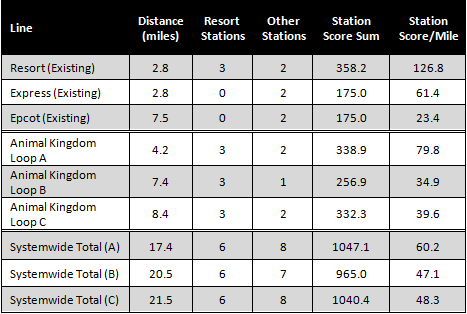
Animal Kingdom Loop C drops the stop at the All Star resorts and goes to Coronado Springs instead.


Generally, all three Animal Kingdom loops strike me as being somewhat poor choices for construction because of the long length of the lines and the way the resorts are laid out straddling the swamps of Reedy Creek.

Epcot Transfer Station


Like the resorts near Animal Kingdom, the resorts near Epcot are spread across both sides of a swampy body of water (the Sassagoula River). But the Epcot resorts are even more difficult to connect by monorail because the center of this section of the resort is home to the Lake Buena Vista Golf Course. For obvious reasons, any proposed monorail extension would need to avoid crossing a golf course or the impacted parts of the golf course would need to be reconstructed to avoid the alignment.

As a result, the Epcot Loop A gets a strange amoeba shape and is an unwieldy long route.


Epcot Loop B dispenses entirely with the idea that the monorail needs to serve the Downtown Disney area. However, it would be rather strange if the only hotels with direct access to the front entrance of Epcot had some of the least futuristic themes of all the Disney World resorts.


Epcot Loop C adds a stop at Old Key West by following the resort entrance road to the water taxi dock.


Epcot Loop D ignores the Port Orleans area entirely and just serves the Downtown Disney/Typhoon Lagoon area.


I was unhappy with how long Epcot Loop D was considering that it only stopped at one resort. So I decided to add stops for the resorts at Hotel Plaza Blvd. The Hotel Plaza Blvd South station is located near the Wyndham, Holiday Inn, and the Hilton resorts. The Hotel Plaza Blvd North station is near the Best Western, Doubletree, and the B resorts. Finally, I added a station at the Buena Vista Palace resort. Although these resorts are not owned by Disney, they are located on land owned by Disney. Therefore, the feasibility of these stations is similar to that of the station at the Swan and Dolphin.

For Epcot Loop E, I also added stations at Downtown Disney West Side and the Downtown Disney Marketplace. The station labeled Downtown Disney may or may not be included in a final version of this alternative. Regardless of how many stations are located at Downtown Disney, I only gave this alternative the station score points as if it stopped at Downtown Disney just once.


Somewhat surprisingly, the Station Score per Mile of the Epcot monorail loops are fairly consistent. In a complete build out, it is possible that Alternatives B or C could be built in addition to Alternatives D or E.


Next time I will discuss the possible combinations of routes I can combine to develop a complete system. The system-wide Station Score per Mile will help me identify the top ideal build outs of a Disney World monorail system. If there are any possible monorail networks that have a higher score than the existing monorail, it will be kind of cool.